More than two decades ago, I made two log sofas for our rustic cedar home. We had hundreds of poles that resulted from thinning our douglas-fir forest. I later developed a fairly unique style of building with logs, but this was my first attempt. I didn't have a tenon cutter, so the joinery I settled on was to use a hole saw to define a circle on the side of a log and then chisel it out so that the joining log would fit into the hole. If necessary, I trimmed the joining log to fit. I used a 1" dowel as a floating tenon. The resulting joints looked pretty good and were extremely strong.
That part I think I got right, but another part I got wrong. At the time, I thought the logs needed to be very smooth, and this was before I got into hand tool woodworking, so I used an angle grinder with abrasive disks to smooth the logs. Later on, I achieved much nicer results with a drawknife, deliberately leaving on wide flats and sections of the tree's outer layers beneath the bark. This is rustic furniture and it looks best with a very natural appearance.
We used the sofas for years and then gave them to some friends. They offered them back to us recently and my wife is very nostalgic about anything associated with our kids growing up, so I reluctantly agreed to try to refurbish and improve them for our family room. Here is the stripped down skeleton:
The joinery is still solid and, with some accumulated scratches and dents, the sofas are in good condition. The upper pole is across the back of the posts so the back will be angled to produce a reclined seating position. I wanted to add a nice back to the sofa that would be more reclined, so I used a drawknife and a spokeshave to create a flat on the inside of the top pole. I had some old poles to make the back, most about 4 inches in diameter. To do this, I sliced the poles in half on the bandsaw. It's pretty easy to do this by attaching a 2x4 to the pole with screws that rides along the fence. By slicing all the poles exactly in half you get a nice, quarter-sawn face. Then I just ripped out one inch thick boards. Here's what they look like:
and here's the refinished sofa:
The templates are to to give to the upholsterer. We are going to upholster the seat in a solid color and leave the back exposed. There will be colorful, Pendleton wool pillows placed along it.
Showing posts with label Small logs. Show all posts
Sunday, December 4, 2016
Friday, June 17, 2016
Grooves and beads
I have the Veritas small plow plane that is a few years old and was somewhat disappointed when I read that Lee Valley was coming out with a new version that can do beading as well. A bit further down in the description, however, was the news that for $59 (including shipping both ways) the company will re-machine your older plane so that it will be able cut beads. As a bonus, they also upgrade the depth stop, which had a tendency to slip. I jumped at the chance.
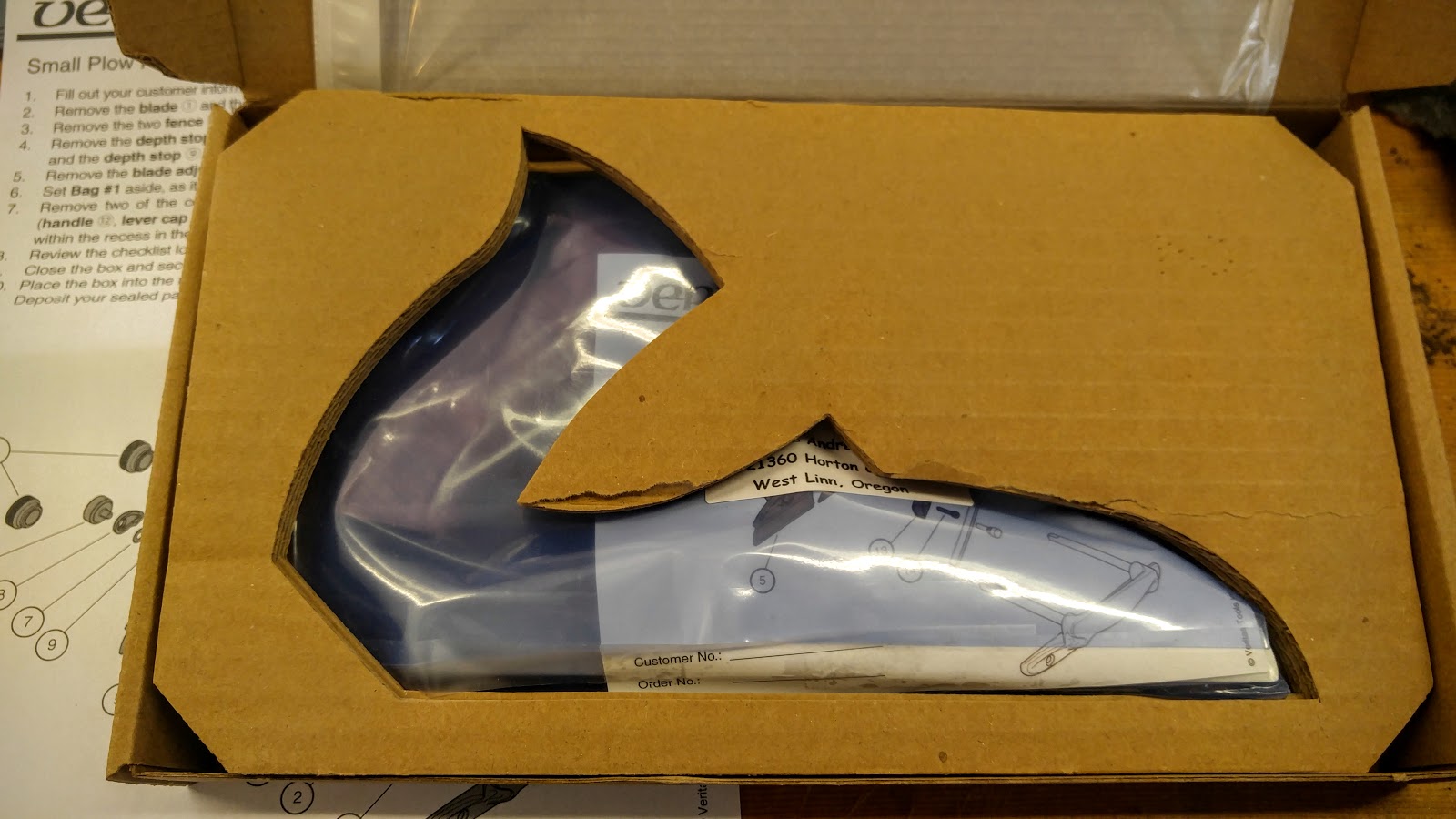
Yesterday in the mail I received the kit:
In typical Lee Valley fashion, they send you detailed instructions on how to disassemble the plane, bags for the parts you keep and for the parts you send them (which has an anti-rust coating), a custom shipping box and an envelope with a reverse postage stamp. Took only a few minutes to have my plane tucked in and cozy:
Stay tuned. I am writing about this now because they are only doing this through August, so, if you own one of these planes, get cracking.
There is a larger point here. It pleases me tremendously that Lee Valley is thinking about and caring about its customers this way, that they still know you after the sale. You don't run into this too often. I often hear and read that customers won't pay for this, but I sure will and it makes me a loyal Lee Valley customer. I don't know about you, but I am tired of buying things and throwing them away when they break or new models come out. No wonder the landfills are full.
Monday, April 9, 2012
A small walnut log
This will be my last post about using small logs, promise. Some years ago, I cut a small walnut tree, less than 12" at the stump, that was in the way. I dragged the trunk and a few of the larger limbs into the barn and promptly forgot it. Several years later I looked at it expecting it to be ruined but, to my surprise, it wasn't. About that time, we bought a king size mattress, so I decided to build a headboard. I had very little material, so I had to be creative. I was able to get enough 2x6s for the rails and stiles and then I sliced the limbs for the slats. They have live edges and you may be able to see the worm holes in several places. The rails and stiles are joined with mortise and tenon joints and the slats are attached with loose tenons.
This was an extremely simple project to make but, years later, it remains one of my favorites. It has great visual interest because of the variegated colors and I routinely run my fingers along the live edges.
Sawing up small logs on a bandsaw is not as difficult as you might think. I made a basic sled/fence with a runner to fit in the miter gauge slot. The logs were attached to the fence with two screws on the ends, shimmed out as appropriate. A better way to do it would be to make a variant of the sled in Shopnotes a while back for cutting tapered table legs. It had T track installed perpendicular to the direction of travel that allowed the fence to adjust to any width/angle.
Friday, April 6, 2012
More on small log furniture
I went on to make a number of other items from these very small logs, a few of which I picture below. Mortise and tenon joinery works very well with only two perpendicular faces and the peeled logs took finish nicely. You may or may not like the look and the juxtaposition of the quartersawn faces with the live edges is admittedly unusual. The main point here is not to display these particular pieces but to get you thinking about things you might do with small logs. They are quite easy to obtain and transport as no one wants them for anything other than firewood.
Wednesday, April 4, 2012
Small logs
There's a story behind this:
Until five years ago, we lived on 40 acres, most of which were covered by second growth douglas fir. It had been untouched since being clearcut perhaps 3 decades before, so the forest was choked with far too many trees and brush. I spent years clearing the brush and thinning out the douglas firs. One result was that I had many logs that were too small to have commercial value that I wanted to find a use for.
One day, in very early spring, I had an idea. I selected several dozen nice logs and used a drawknife to peel them. At this time of year, they peel very easily and, with care, I got a nice surface, very natural in appearance and showing few tool marks. Then, I cut them into 6 foot lengths, quartered them on my bandsaw and put them away in the barn for a year. My reasoning was that this would prevent the wood from splitting, which it did. I ended up with pie slices of perhaps 80 degrees after radial shrinkage.
During that year, I decided to build a Morris chair and, for some reason, the idea came to me to build it with the quartered douglas fir. What you see is the result. The joinery was mostly completed with hand tools. I dealt with the irregular surface by attaching square scraps of plywood to the ends, so the logs would sit flat on my bench.
I have made numerous other items in my house from these logs, some of which I will post later. I really like them and am pleased with what I allow myself to think is an original idea, though I am sure it is not.
The major point of this post is that it is possible to find good uses for small logs that we think of as having no value. I have gone on to extend this idea and will post some of the results later. To my eye they are quite beautiful, not because of my craftsmanship but because of the visual interest which small live edge pieces can create. So, if you have access to small logs, what can you do with them?
Subscribe to:
Posts (Atom)