Showing posts with label Shop stool. Show all posts

Monday, May 29, 2017

My last shop stool post ever--promise!

I continued to struggle with this project because I felt very strongly that I was onto something, but I just couldn't get it right.  I can't design anything without making a prototype or, in the case of this shop stool, multiple prototypes.  It was getting really aggravating.  Then Gerry made a  comment on my last post:
Andy: How about a circle for the base, with the seat pedestal set to one side. If the base was 1 1/2 -2" thick you could ease the bottom front to accommodate rolling forward as well as right and left. A dense hardwood might give the weight needed to keep it upright.   
Even though I didn't want to do exactly what he suggested, Gerry's comment was the insight I needed and I knew immediately what I did want to do.  My prototypes taught me that my ideal stool would have the wooden bicycle seat mounted on a long thin stem and Gerry's idea was that it should be attached to a heavy round object at the base.  I retrieved a 10 lb. weight from my weightlifting machine, drilled four counterbored holes in it, cut off two short pieces of 2x4, grabbed a scrap of closet rod, drilled two 1 1/2" holes and there it was, exactly what I had been groping for all this time:


I know this is arguably ugly, but it works great and does have a certain modernist appeal.  You really have to work at it to knock this stool over and the rounded edge on the weight lets it move easily in all directions.  It's very comfortable and allows a wide range of movement.

This one doesn't incorporate height adjustment because I knew exactly how high I wanted it to be, but it wouldn't be difficult to add.  I am not sure if this is a coincidence, but the height I chose by feel is exactly 1/2" less than my inseam.  The important thing is that your knees be slightly bent.

This sort of active stool, as I have called it, is obviously not for everyone.  The bicycle seat is ideal because you can move around without sliding, but you probably have to be a bicycle rider to appreciate this.  For me, though, it is the ideal shop stool, just what I wanted.

I look at it now and can't understand what took me so long.  Now that I can see it, this design seems so obvious that it is almost embarrassing that I floundered around.

I am done.

Monday, January 16, 2017

Not stools again!

Yes, stools again.  I have become really interested in the design of stools, which are the most basic, and maybe the oldest, form of seating.  Designing stools has allowed me to learn a lot without the additional complexity of a chair.  I am amazed at all the details that go into a well-designed stool.

If you look at my shop stool topic on the right side of this page, you will see my various versions of a bicycle seat shop stool, which were received with understandable skepticism; nevertheless, I am convinced I am on to something.  Over the past year, I have tweaked it repeatedly because I know I am not there yet.

For the shop, I am interested in a type of stool I call "active seating,"  meaning a stool you are going to do physical work from.  It has to let you go about your tasks with agility and power.  Here are some principles I have adopted:
  1. Active stools have basically one leg.  It's really three-legged, but the other two are yours.  The stool itself needs to have three legs, as close as you can come to a single leg and still have a stool that will stand by itself when you aren't sitting on it.  Four legs are bad for an active stool;
  2. Active stools put you into a position where you are almost standing but with your knees slightly bent, a position of power and agility that you see throughout nature and sports.  This position is what lets your legs act as the other two legs of a stool and still take weight off them.
  3. Active stools will move with you to extend your reach.  Tippiness forward and to the sides is good when you are sitting on it and bad when you aren't, because you don't want the stool to fall over when you get up.  In practice, this means that one leg points straight forward while the other two point back.
  4. Active stools have a low center of gravity.  This is what promotes a narrow base for tippiness while still allowing the stool to be stable when you get up.
  5. Active stools have to be either custom fit for a single person, or highly adjustable.  There's a reason bicycle seats are so highly adjustable.
You would be amazed at how comfortable and functional a stool that follows these principles is.  We're used to stools you sit on not with, your legs out of action; this is completely different.

So, after a number of iterations, here is where my efforts stood.  I tweaked the base by tipping the stool forward slightly and adding another block on the rear of the base for stability and to lower the center of gravity.


It does a pretty good job of implementing the principles, but there is a problem:  this is about the ugliest and most ungainly looking stool I can imagine.  In part, that's because the entire thing is made of scraps, but basically it's just ugly.  I have come to think of it as what automotive designers call a development mule.  I want to tweak it yet another time with a new version that addresses some functional issues and hopefully begins to look a little more acceptable.

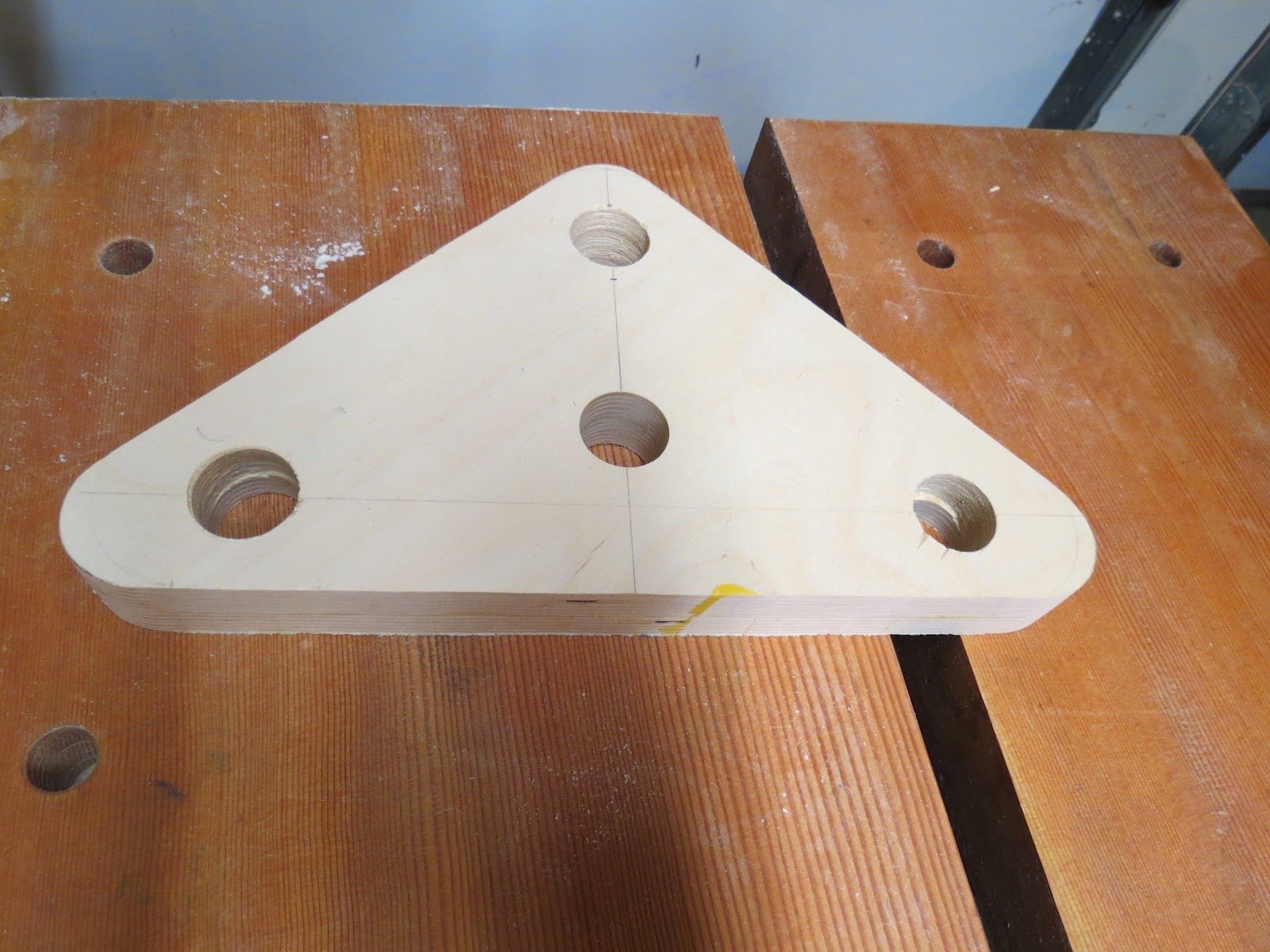
Because it should be a three-legged stool and because it has a bicycle seat, I settled on a triangular platform for a low base in order to help keep the center of gravity low:


Short legs raise it up to the desired height.  The resulting stool was comfortable and functioned very well but was still unstable when I wasn't sitting on it, having a tendency to tip over if bumped.  I addressed this problem by experimentally adding mass to the base:

Yup, that's a dowel with two 5 lb weights on it.  I did this so I could figure out how much weight to add.   Ten pounds is about right.

Functionally, it was now right, but it was obviously still very much a development mule.  I've learned what I can learn and I am done with it.  The seat is right but I want an entirely different kind of base.  What I have in mind is like an antique, three-legged piano stool with a bicycle seat instead of the traditional round seat.  You can buy a great piece of hardware for this, but I am going to figure out something more economical.

Maybe you are thinking, "Why don't you just build a high piano stool and be done with it?"  It's because woodworking requires much more power than playing a piano.  You have to be in the position I have described and able to use the strength of your legs.  The bicycle seat is what allows you to do that.

In a sense, this project was a failure.  I spent a lot of time and, in the end, I am cutting off the seat and burning the rest.  However, I learned a lot.  More important, though, is that when I am trying to be creative, failure is a part of success.  In business, I used to say to my clients, "I will give you five ideas, four of which are almost certainly stupid, but one of them may be really good.  Problem is, I don't know which is which."  This is a darn good record and the effort to explore is worth it.  Many people don't succeed because they are unwilling to fail.


Tuesday, November 10, 2015

Bicycle seat shop stool, Pt. III

You may be wondering, "Why is this guy obsessing about a shop stool?"  The answer is that about a decade ago I permanently injured both of my feet on an epic, one week 450 mile bicycle ride in the mountains.  It has become progressively worse and now I can't stand at my bench for long periods without substantial pain.  I have an appointment with an orthopedic surgeon to see if anything can be done but, in the meantime, I want to work comfortably.  Beyond that, though, I have enjoyed the design challenge because I think I may be on to something.

In my last post about this shop stool, I hinted that, despite its advantages, I didn't like the way it looked:
I concede that it doesn't push the upper bound of the woodworking aesthetic. :(   I have an idea for the next version that I think would look fantastic while retaining the functionality of this one.
Turns out that, in addition to not looking right to me, it didn't function too well either.  The bicycle seat and the tall height are clearly right for a woodworking shop stool, in my opinion of course, but it was too stable.  I know that sounds odd, but it's true.   The four legs and high seat height made it hard to get on and off the stool and, once on, you were nailed to the floor, not suitable for woodworking.  I felt that I was almost but not quite there.

I finally realized that this should be a one-legged stool to work well; the other two legs have shoes on them.  The main purpose of the base is to keep the stool upright when you aren't sitting on it.  The stool holds you in the most stable, agile position a two or four legged animal can have--look at the stance of a basketball player on defense, a safety in football, a cougar about to pounce.  That's why you only need one leg on the stool and there is little danger of falling over.  So, with another dive into the scrap pile, here is what I came up with:


I cut off the seat and seatpost, lengthened the column and attached it to a scrap piece of fir 4x6.  I'm done; this is the design I have been trying to get to.  It's compact and easy to move around, looks good (to me at least) and functions extremely well.  You can tip it forward to get on it, just like you tip a bicycle sideways to get on it, and you can lean over the bench while you're working by tipping it forward.  It's unstable in a good way.  I'm really happy with it, finally.

The funny thing is that, although this is probably the best original design I have ever done, I doubt anybody other than me likes it.  It just looks weird and it probably isn't apparent to anyone other than possibly an avid bicycle rider what a great work position it creates, while taking a load off your feet and legs.  You have to use it to appreciate that.  A one-legged stool seems unstable, even though it isn't because, if it did slip or tip out from under you, you'd just be standing up in a stable position with your knees slightly bent.

There is a popular Saturday craft market in Portland and I have toyed with the idea of making a few for sale there, just to see what would happen.  I have a feeling it would be a bust, but there is a large bicycle community here, so I might be wrong.  I can see a bicycle mechanic really liking it.  For the time being, I think I will just use it and enjoy it.

One more thing.  My wife is so happy that I spent all Saturday morning making her a mid-century modern plant stand:


If you look at the picture of the prior version of the stool, you may be able to guess why it took me fifteen minutes to build.  :)


Tuesday, April 14, 2015

Bicycle seat shop stool, Pt. II.

I enjoyed all the comments on my first post about the stool project, including the humorous ones; I'm really having fun with this.

With the seat made and attached to the seat post--a scrap 1 1/4" dowel 16" long--I had to figure out a base.  Since I wanted the stool to be 34" tall, I obviously had to attach the seatpost to a platform and add legs for this prototype.  I had two ideas for the platform:  a triangle with three legs or a square with four legs.  I tried the triangle first and it worked fairly well.  I splayed the legs slightly and put the middle leg in the back so I wouldn't fall over backward.  There is no need for forward stability when the stool is in use because my feet are flat on the floor in front and I am nearly standing up anyway.  Any force I apply with tools will push me backward.  Dry fit, it was very stable to sit on but it tipped over easily if I bumped it when not in use.  The center of gravity of the seat was too high and too far forward because of where I attached the seatpost to the platform.


The next option I tried was a square with the seatpost in the exact center, four legs and the seat oriented on the diagonal.  My reasoning was that then the platform wouldn't interfere with my legs and it would be very stable when I am on or off the stool.  Here it is:


The platform is 1 1/2" thick to allow for strong attachments of the seatpost and legs.  I didn't like the way it looked very much though, to me like a giraffe.  I think the triangle looked better for some reason--maybe because the seat is triangular--and I have a preference for three legs.  Looking back, I wish I had made the platform an equilateral triangle to increase its depth and allow the seatpost to attach further back.  Hmmmm, might have to make another version from scratch.  What to do.

Then a brain shower happened (a brain shower is to a brainstorm as a rain shower is to a rainstorm--a passing event that may or may not amount to anything much).  A problem with my first version was that the height isn't adjustable, which is OK for me because I know the exact height I want, but not OK for most.  A bicycle seat is adjusted by sliding the seatpost up and down inside the downtube and gets locked in place.  I could modify my prototype and still use only scraps by creating a "downtube."  So, I decapitated the giraffe and cut off its legs:


Then I laminated a down column and inserted it between the platform and the seatpost:


I like this much better and the lower center of gravity is more stable, but I think the way to go is to lower the platform to be just off the floor, shorten the seatpost and have a longer column.  I am going to use this one awhile before making another version.

The two main ideas in my design that I very strongly urge you to consider if you want to make a shop stool are to make the seat shaped like a bicycle seat and make the stool very high, just low enough to keep a very slight bend in your knees.  I think you will be surprised at how well this works.  It does take some getting used to but you'll quickly get accustomed to it.  I suppose this is more familiar to a bicycle rider though and this certainly isn't a stool for everyone.  I concede that it doesn't push the upper bound of the woodworking aesthetic.  :(  I have an idea for the next version that I think would look fantastic while retaining the functionality of this one.

NB:  Ralph, the Accidental Woodworker, comments that it looks like the stool would fall over backward easily.  Obviously, the bigger the base the less likely this is; it's a tradeoff.  If you build one, make your own decision.  I was concerned about this and tested my prototype in a safe place before using it.  You should too.  This stool depends in part on your legs for stability so keep them flat on the floor.

Tuesday, April 7, 2015

OK, this is bizarre but ...

I have a brainstorm.  The thing about my brainstorms is that many of them don't pan out, but sometimes they do with very satisfying results.  Hey, hitters in baseball are considered good if they can bat .300.  To have my idea make any sense at all though, I have to give you some background as to how disparate ideas came together.

A decade ago, I severely and permanently injured the joints at the base of my second toes on a grueling 425 mile, one week bicycle ride in the mountains due to misadjustment of the clipless pedal attachments to my shoes.  Stupidity.  I have learned to be very picky about shoes, but my feet ache badly at night if I am on them all day.  As a result, I need a stool at my workbench but, for reasons that will become clear, no stool I have ever seen works for me.

I found Chris Schwarz's folding campaign stool very intriguing.  Here's some good pics.    It looks odd at first.  The seat is triangular and concave; you sit in it with one of the points between your legs.  The best backpacker stools are similar.  I think this general design evolved to best meet the needs for an "active stool," one in which your legs are required to be used for stability and the seat is secure and comfortable.

I think the ideal woodworker's stool keeps you in a nearly standing position with your knees only slightly bent.  That keeps you at a good height above the bench and allows you to use the power in your lower body when necessary.  This is a very natural and athletic position; look at a player on defense in basketball or a predator about to pounce.

Then it hit me.  This is exactly the position your lower body is in on a bicycle when the pedal is straight down.  I have often struggled to help people adjust their seats because having the seat so high that your knee is only slightly bent when fully extended feels unnatural and even dangerous at first but most soon find that it works the best.  Also, and this is key for me, long distance riders are very sensitive about their seat, pun intended.  A good touring saddle costs over $100 and is very carefully shaped for movement and comfort.  The shape is surprisingly similar to the campaign stool: triangular and concave.  I'd argue that bicyclists pay more attention to active seating than anybody else and I think the lessons learned may be applicable to woodworking.  That's what I am going to try.

My rule when designing a prototype is to only use material I have on hand.  It's just what I like to do, in part because I am unable to create a plan when I am designing something; I have to see how it looks, works and, in this case, feels.  That means I sometimes run into dead ends and have to start over.

I thought about buying a good bicycle seat and seatpost and mounting it on a stool base, which would be a very good but costly option I think, but I decided to have some fun instead:  I would replicate the shape of my touring seat in wood!  Hey, don't laugh:  here in Portland some bikes are made from wood.  So I decided to make the stool from baltic birch plywood and some 1 1/4" dowel pieces I have.

I laminated three pieces of baltic birch plywood together to give room for shaping and a secure attachment of the seat to the base of the stool.  Then I traced out the shape of my touring seat in three dimensions and cut it out on my power bowsaw.  :)  To get the contour you have to cut from the top and the side, like you do for a cabriole leg.  After some work with rasps and files, the result was better than I expected.  It is quite comfortable and a reasonably good match.  Appearance is a matter of taste, but I think the plies create an interesting look; they also provide reference lines for shaping.  Since this seat isn't adjustable like they are on bicycles, I carefully matched the orientation on the seat dowel to match what is comfortable for me on my bikes.  I was surprised to find that the seats on my bikes were all exactly parallel to the ground even though I had adjusted them entirely by feel.  If you sit on that seat for 6 hours, it has to be just right.


Making this caused me to think about why a bicycle seat is designed the way it is.  I think it allows your legs to move freely while holding you steady in a fixed, centered position on the seat and being comfortable.  It's basically the same with the campaign stool.  I rarely pay attention to how sophisticated the designs of common objects are, though it is interesting when I do.  In many well-made things you can see the accumulated experience of many people over many years.

So, I have the seat.  I suspect that most of you will think I am absolutely crazy, but having sat on a bicycle seat for thousands of miles, I know that this will be comfortable, although I don't know if it is suited to woodworking; the only way for me to find out is to try it.  Now I have to decide what is between the seat and the floor.